

Blog
/
Email
/
December 15, 2025

Beyond MFA: Detecting Adversary-in-the-Middle Attacks and Phishing with Darktrace

During a customer trial of Darktrace / EMAIL and Darktrace / IDENTITY, Darktrace detected an adversary-in-the-middle (AiTM) attack that compromised a user’s Office 365 account via a business email compromise (BEC) phishing email. Following the breach, the compromised account was used to launch both internal and external phishing campaigns.
Inside the SOC
Darktrace cyber analysts are world-class experts in threat intelligence, threat hunting and incident response, and provide 24/7 SOC support to thousands of Darktrace customers around the globe. Inside the SOC is exclusively authored by these experts, providing analysis of cyber incidents and threat trends, based on real-world experience in the field.
Written by
David Ison
Cyber Analyst
Written by
Ryan Traill
Analyst Content Lead
Beyond MFA: Detecting Adversary-in-the-Middle Attacks and Phishing with DarktraceDefault blog imageDefault blog imageDefault blog imageDefault blog imageDefault blog imageDefault blog image
15
Dec 2025

What is an Adversary-in-the-middle (AiTM) attack?

Adversary-in-the-Middle (AiTM) attacks are a sophisticated technique often paired with phishing campaigns to steal user credentials. Unlike traditional phishing, which multi-factor authentication (MFA) increasingly mitigates, AiTM attacks leverage reverse proxy servers to intercept authentication tokens and session cookies. This allows attackers to bypass MFA entirely and hijack active sessions, stealthily maintaining access without repeated logins.

This blog examines a real-world incident detected during a Darktrace customer trial, highlighting how Darktrace / EMAILTM and Darktrace / IDENTITYTM identified the emerging compromise in a customer’s email and software-as-a-service (SaaS) environment, tracked its progression, and could have intervened at critical moments to contain the threat had Darktrace’s Autonomous Response capability been enabled.

What does an AiTM attack look like?

Inbound phishing email

Attacks typically begin with a phishing email, often originating from the compromised account of a known contact like a vendor or business partner. These emails will often contain malicious links or attachments leading to fake login pages designed to spoof legitimate login platforms, like Microsoft 365, designed to harvest user credentials.

Proxy-based credential theft and session hijacking

When a user clicks on a malicious link, they are redirected through an attacker-controlled proxy that impersonates legitimate services.  This proxy forwards login requests to Microsoft, making the login page appear legitimate. After the user successfully completes MFA, the attacker captures credentials and session tokens, enabling full account takeover without the need for reauthentication.

Follow-on attacks

Once inside, attackers will typically establish persistence through the creation of email rules or registering OAuth applications. From there, they often act on their objectives, exfiltrating sensitive data and launching additional business email compromise (BEC) campaigns. These campaigns can include fraudulent payment requests to external contacts or internal phishing designed to compromise more accounts and enable lateral movement across the organization.

Darktrace’s detection of an AiTM attack

At the end of September 2025, Darktrace detected one such example of an AiTM attack on the network of a customer trialling Darktrace / EMAIL and Darktrace / IDENTITY.

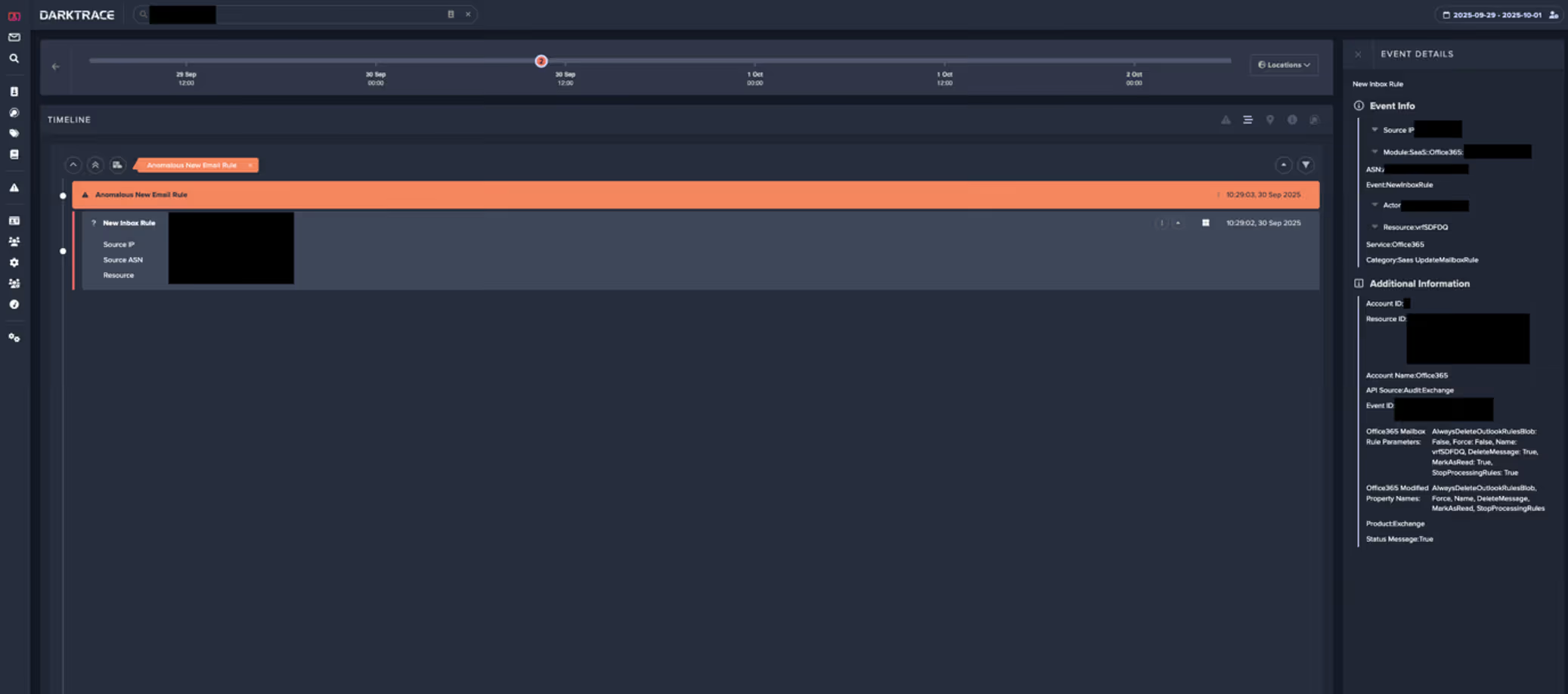
In this instance, the first indicator of compromise observed by Darktrace was the creation of a malicious email rule on one of the customer’s Office 365 accounts, suggesting the account had likely already been compromised before Darktrace was deployed for the trial.

Darktrace / IDENTITY observed the account creating a new email rule with a randomly generated name, likely to hide its presence from the legitimate account owner. The rule marked all inbound emails as read and deleted them, while ignoring any existing mail rules on the account. This rule was likely intended to conceal any replies to malicious emails the attacker had sent from the legitimate account owner and to facilitate further phishing attempts.
Darktrace’s detection of the anomalous email rule creation.
Figure 1: Darktrace’s detection of the anomalous email rule creation.

Internal and external phishing

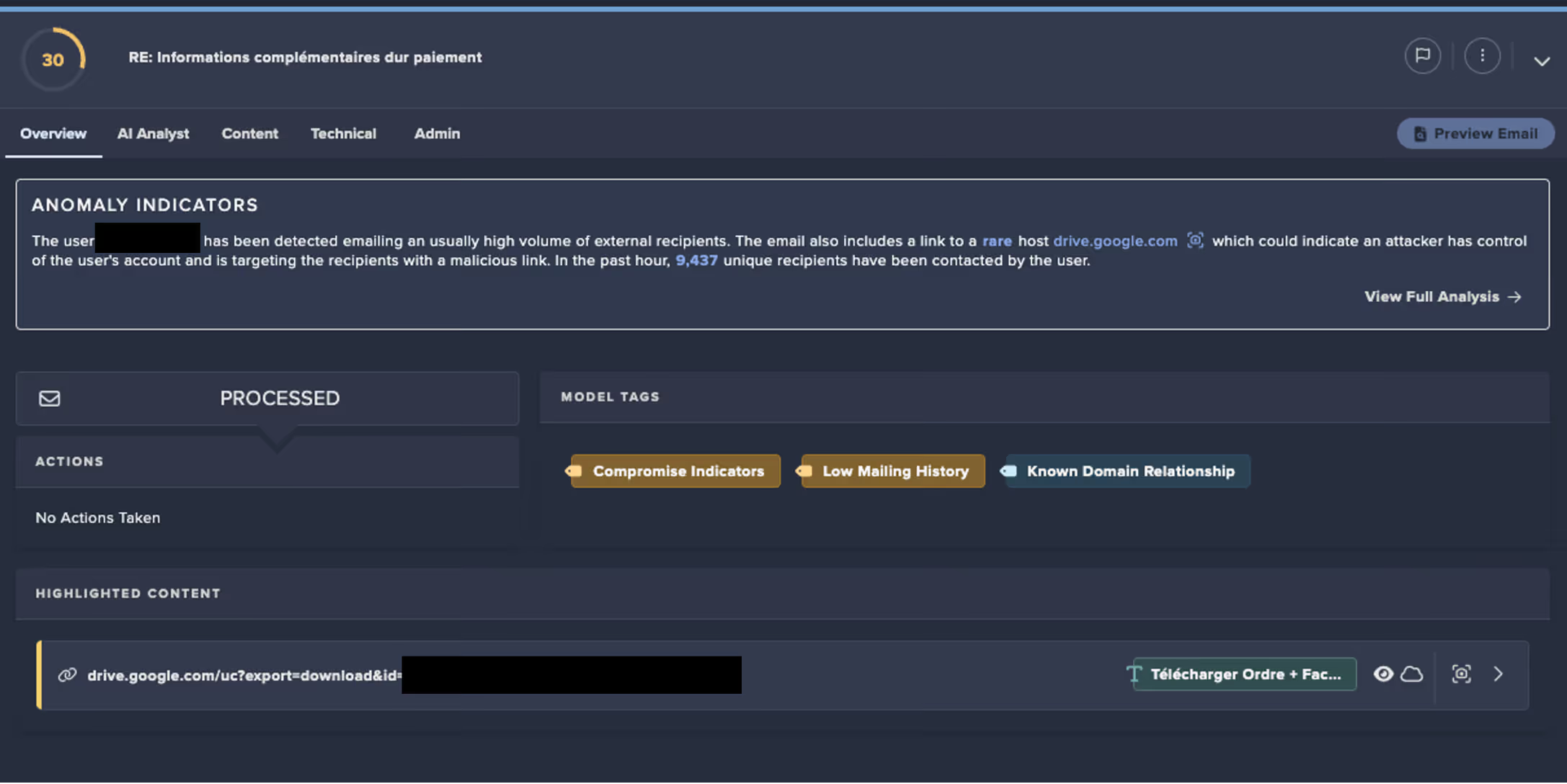
Following the creation of the email rule, Darktrace / EMAIL observed a surge of suspicious activity on the user’s account. The account sent emails with subject lines referencing payment information to over 9,000 different external recipients within just one hour. Darktrace also identified that these emails contained a link to an unusual Google Drive endpoint, embedded in the text “download order and invoice”.

Darkrace’s detection of an unusual surge in outbound emails containing suspicious content, shortly following the creation of a new email rule.
Figure 2: Darkrace’s detection of an unusual surge in outbound emails containing suspicious content, shortly following the creation of a new email rule.
Darktrace / EMAIL’s detection of the compromised account sending over 9,000 external phishing emails, containing an unusual Google Drive link.
Figure 3: Darktrace / EMAIL’s detection of the compromised account sending over 9,000 external phishing emails, containing an unusual Google Drive link.

As Darktrace / EMAIL flagged the message with the ‘Compromise Indicators’ tag (Figure 2), it would have been held automatically if the customer had enabled default Data Loss Prevention (DLP) Action Flows in their email environment, preventing any external phishing attempts.
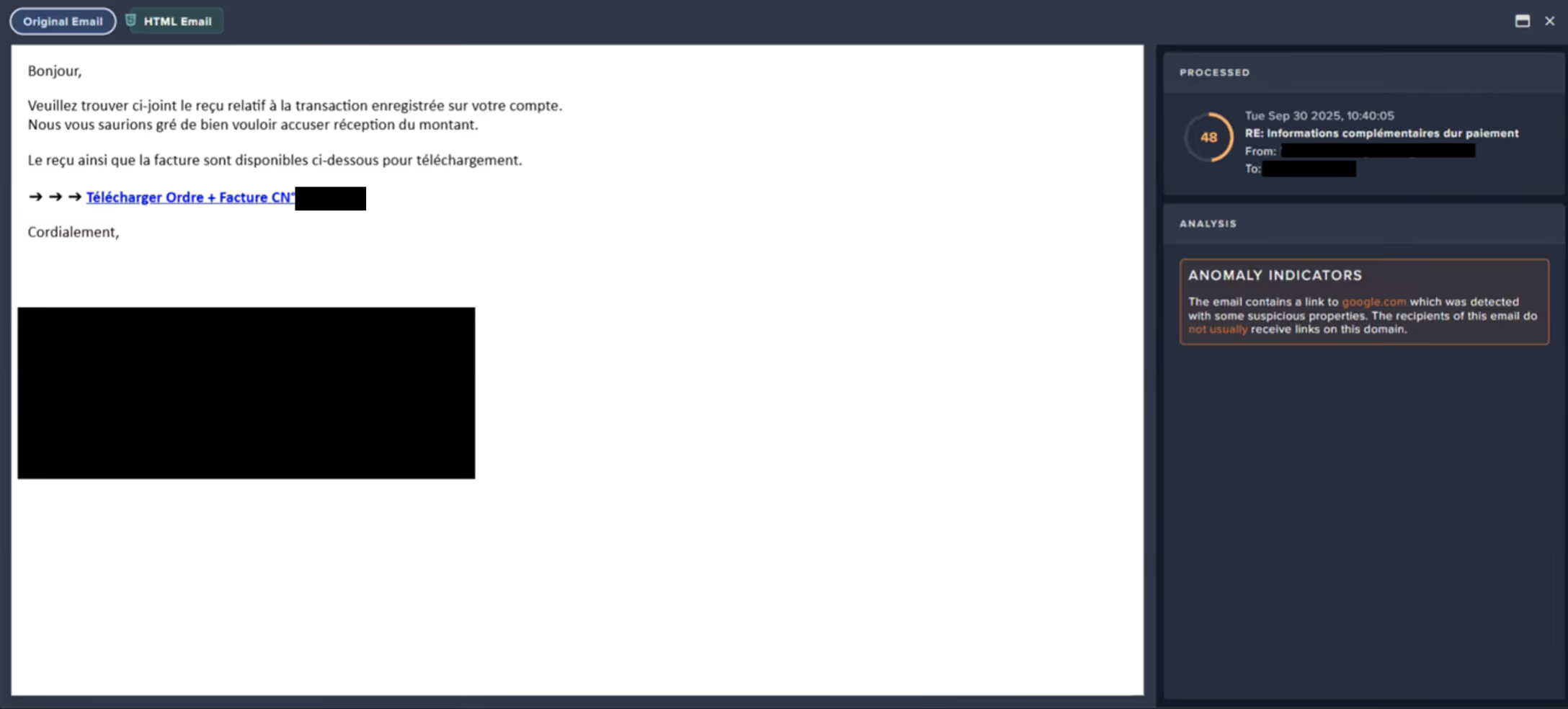
Figure 4: Darktrace / EMAIL’s preview of the email sent by the offending account.

Darktrace analysis revealed that, after clicking the malicious link in the email, recipients would be redirected to a convincing landing page that closely mimicked the customer’s legitimate branding, including authentic imagery and logos, where prompted to download with a PDF named “invoice”.
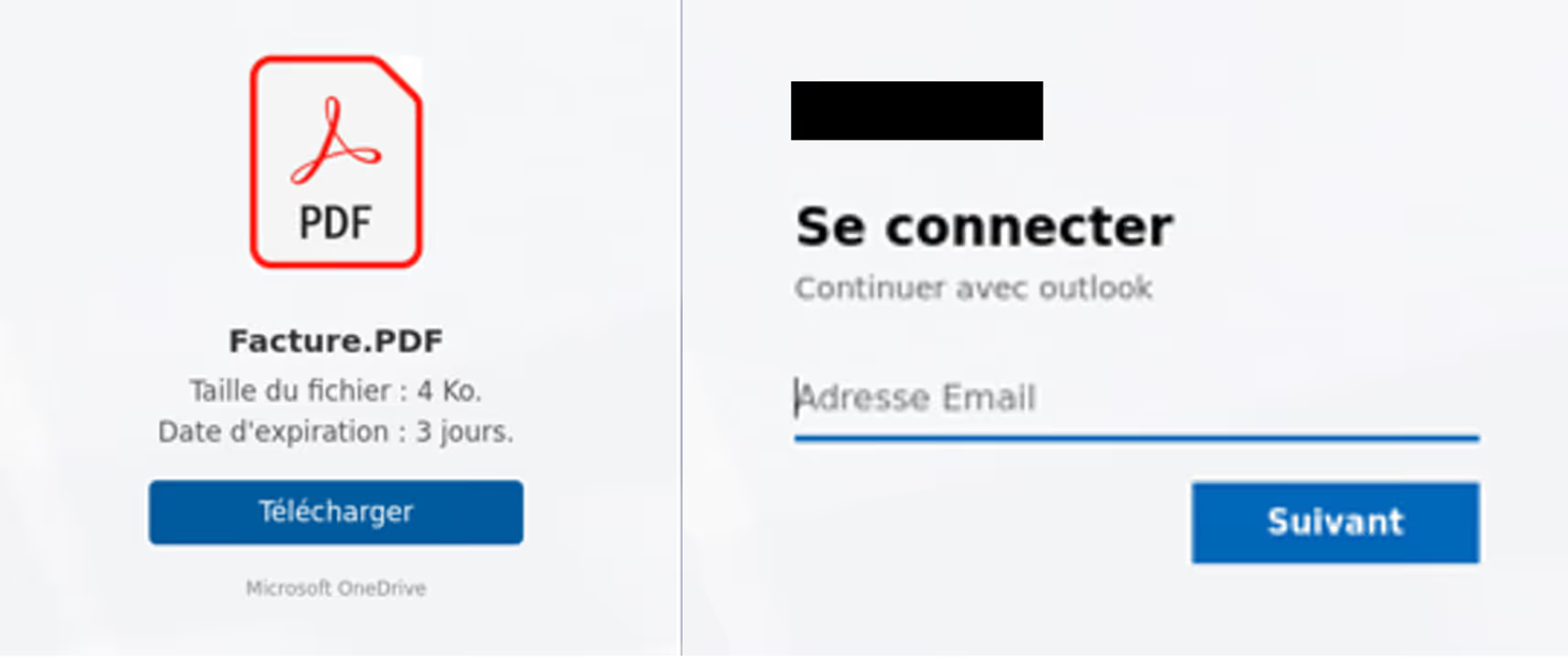
Figure 5: Download and login prompts presented to recipients after following the malicious email link, shown here in safe view.

After clicking the “Download” button, users would be prompted to enter their company credentials on a page that was likely a credential-harvesting tool, designed to steal corporate login details and enable further compromise of SaaS and email accounts.

Darktrace’s Response

In this case, Darktrace’s Autonomous Response was not fully enabled across the customer’s email or SaaS environments, allowing the compromise to progress,  as observed by Darktrace here.

Despite this, Darktrace / EMAIL’s successful detection of the malicious Google Drive link in the internal phishing emails prompted it to suggest ‘Lock Link’, as a recommended action for the customer’s security team to manually apply. This action would have automatically placed the malicious link behind a warning or screening page blocking users from visiting it.
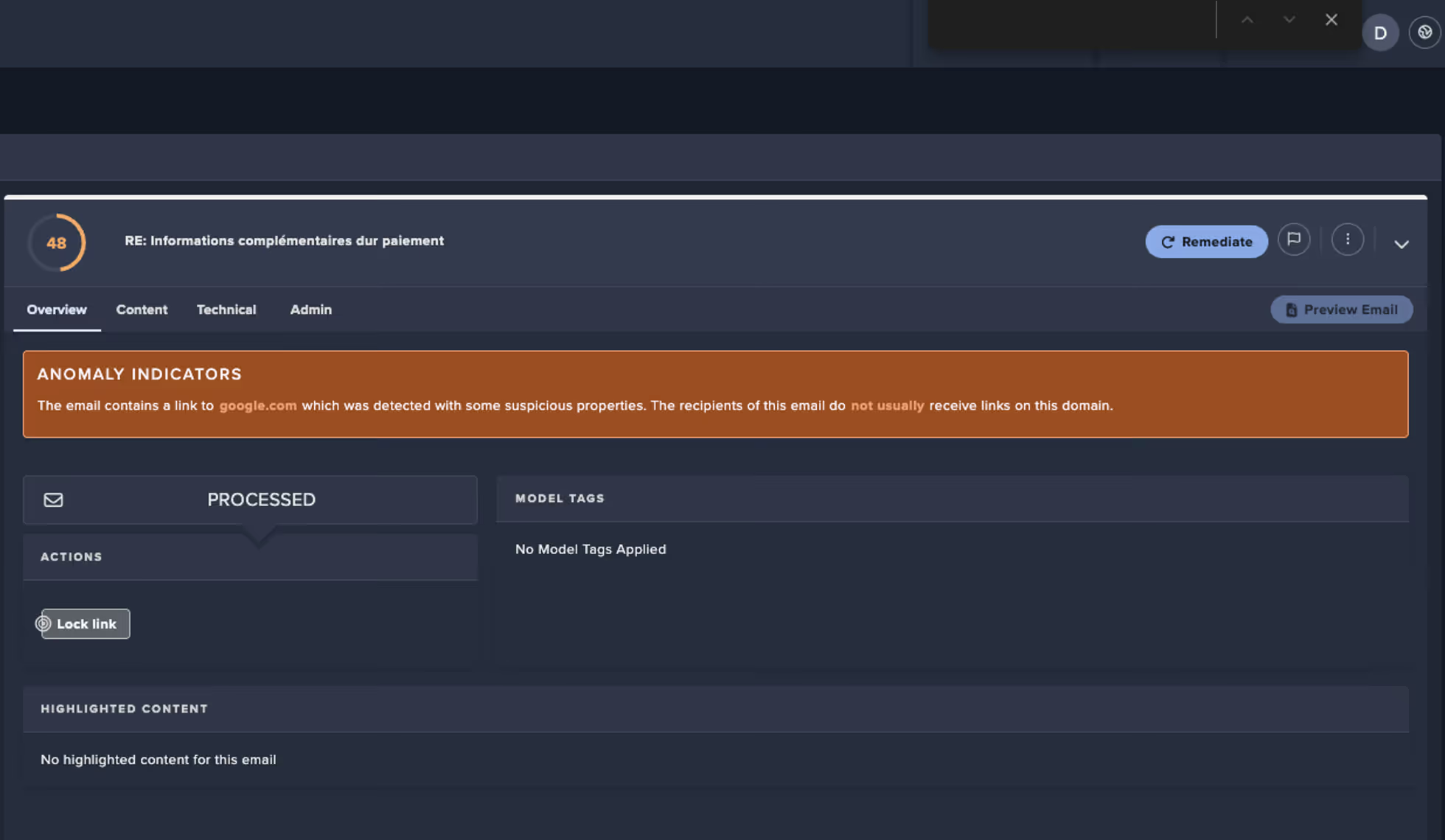
Autonomous Response suggesting locking the malicious Google Drive link sent in internal phishing emails.
Figure 6: Autonomous Response suggesting locking the malicious Google Drive link sent in internal phishing emails.

Furthermore, if active in the customer’s SaaS environment, Darktrace would likely have been able to mitigate the threat even earlier, at the point of the first unusual activity: the creation of a new email rule. Mitigative actions would have included forcing the user to log out, terminating any active sessions, and disabling the account.

Conclusion

AiTM attacks represent a significant evolution in credential theft techniques, enabling attackers to bypass MFA and hijack active sessions through reverse proxy infrastructure. In the real-world case we explored, Darktrace’s AI-driven detection identified multiple stages of the attack, from anomalous email rule creation to suspicious internal email activity, demonstrating how Autonomous Response could have contained the threat before escalation.

MFA is a critical security measure, but it is no longer a silver bullet. Attackers are increasingly targeting session tokens rather than passwords, exploiting trusted SaaS environments and internal communications to remain undetected. Behavioral AI provides a vital layer of defense by spotting subtle anomalies that traditional tools often miss

Security teams must move beyond static defenses and embrace adaptive, AI-driven solutions that can detect and respond in real time. Regularly review SaaS configurations, enforce conditional access policies, and deploy technologies that understand “normal” behavior to stop attackers before they succeed.

Credit to David Ison (Cyber Analyst), Bertille Pierron (Solutions Engineer), Ryan Traill (Analyst Content Lead)

Appendices

Models

SaaS / Anomalous New Email Rule

Tactic – Technique – Sub-Technique  

Phishing - T1566

Adversary-in-the-Middle - T1557

Inside the SOC
Darktrace cyber analysts are world-class experts in threat intelligence, threat hunting and incident response, and provide 24/7 SOC support to thousands of Darktrace customers around the globe. Inside the SOC is exclusively authored by these experts, providing analysis of cyber incidents and threat trends, based on real-world experience in the field.
Written by
David Ison
Cyber Analyst
Written by
Ryan Traill
Analyst Content Lead

More in this series

No items found.

Blog

/

Cloud

/

April 9, 2026

Bringing Together SOC and IR teams with Automated Threat Investigations for the Hybrid World

Default blog imageDefault blog image

The investigation gap: Why incident response is slow, fragmented and reactive

Modern investigations often fall apart the moment analysts move beyond an initial alert. Whether detections originate in cloud or on-prem environments, SOC and Incident Response (IR) teams are frequently hindered by fragmented tools and data sources, closed ecosystems, and slow, manual evidence collection just to access the forensic context they need. SOC analysts receive alerts without the depth required to confidently confirm or dismiss a threat, while IR teams struggle with inconsistent visibility across cloud, on‑premises, and contained endpoints, creating delays, blind spots, and incomplete attack timelines.

This gap between SOC and Digital Forensics and Incident Response (DFIR) slows response and forces teams into reactive and inefficient investigation patterns. Security teams struggle to collect high‑fidelity forensic data during active incidents, particularly from cloud workloads, on‑prem systems, and XDR‑contained endpoints where traditional tools cannot operate without deploying new agents or disrupting containment. The result is a fragmented response process where investigations slow down, context gets lost, and critical attacker activity can slip through the cracks.

What’s new at Darktrace

Helping teams move from detection to root cause faster, more efficiently, and with greater confidence

The latest update to Darktrace / Forensic Acquisition & Investigation eliminates the traditional handoff between the SOC and IR teams, enabling analysts to seamlessly pivot from alert into forensic investigation. It also brings on-demand and automated data capture through Darktrace / ENDPOINT as well as third-party detection platforms, where investigators can safely collect critical forensic data from network contained endpoints, preserving containment while accelerating investigation and response.  

Together, this solidifies / Forensic Acquisition & Investigation as an investigation-first platform beyond the cloud, fit for any organization that has adopted a multi-technology infrastructure. In practice, when these various detection sources and host‑level forensics are combined, investigations move from limited insight to complete understanding quickly, giving security teams the clarity and deep context required to drive confident remediation and response based on the exact tactics, techniques and procedures employed.

Integrated forensic context inside every incident workflow

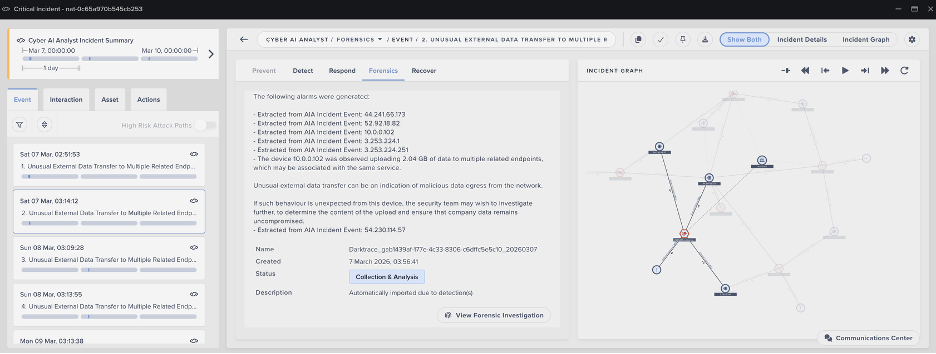
SOC analysts now have seamless access to forensic evidence at the exact moment they need it. There is a new dedicated Forensics tab inside Cyber AI Analyst™ incidents, allowing users to move instantly from detection to rich forensic context in a single click, without the need to export data or get other teams involved.

For investigations that previously required multiple tools, credentials, or intervention by a dedicated team, this change represents a shift toward truly embedded incident‑driven forensics – accelerating both decision‑making and response quality at the point of detection.

Figure 1: The forensic investigation associated with the Cyber AI Analyst™ incident appears in a dedicated ‘Forensics’ tab, with the ability to pivot into the / Forensic Acquisition & Investigation UI for full context and deep analysis workflows.

Reliable automated and manual hybrid evidence capture across any environment

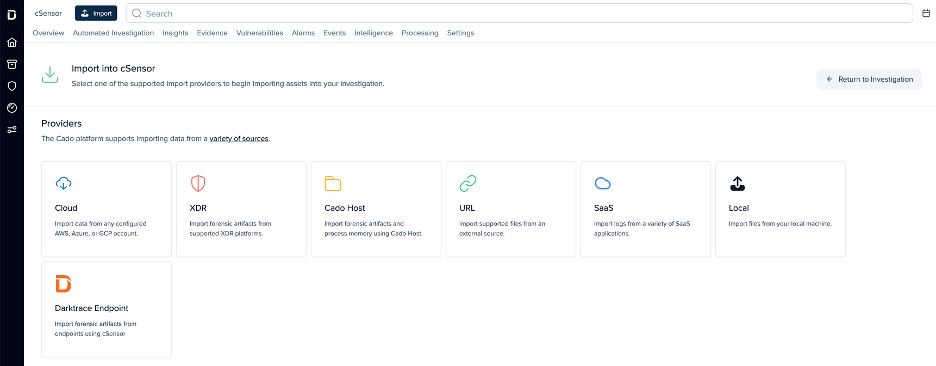
Across cloud, on‑premises, and hybrid environments, analysts can now automate or request on‑demand forensic evidence collection the moment a threat is detected via Darktrace / ENDPOINT. This allows investigators to quickly capture high-fidelity forensic data from endpoints already under protection, accelerating investigations without additional tooling or disrupting systems. Especially in larger environments where the ability to scale is critical, automated data capture across hybrid environments significantly reduces response time and enables consistent, repeatable investigations.

Unlike EDR‑only solutions, which capture only a narrow slice of activity, these workflows provide high‑quality, cross‑environment forensic depth, even on third‑party XDR‑contained devices that many vendor ecosystems cannot reach.

The result is a single, unified process for capturing the forensic context analysts need no matter where the threat originates, even in third-party vendor protected areas.

Figure 2: The ability to acquire, process, and investigate devices with the Darktrace / ENDPOINT agent installed using the ‘Darktrace Endpoint’ import provider
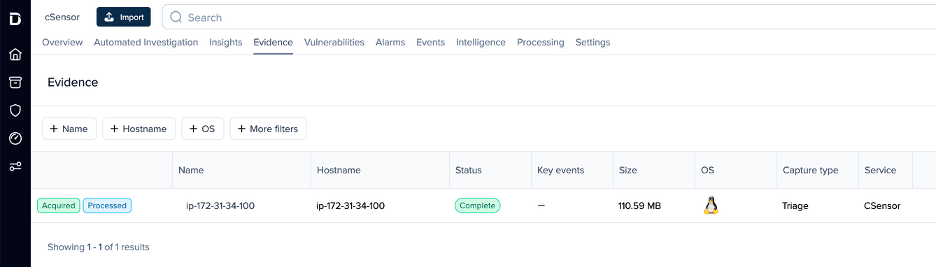
Figure 3: A Linux device that has the Darktrace / ENDPOINT agent installed has been acquired and processed by / Forensic Acquisition & Investigation

Investigation‑first design flexible for hybrid organizations

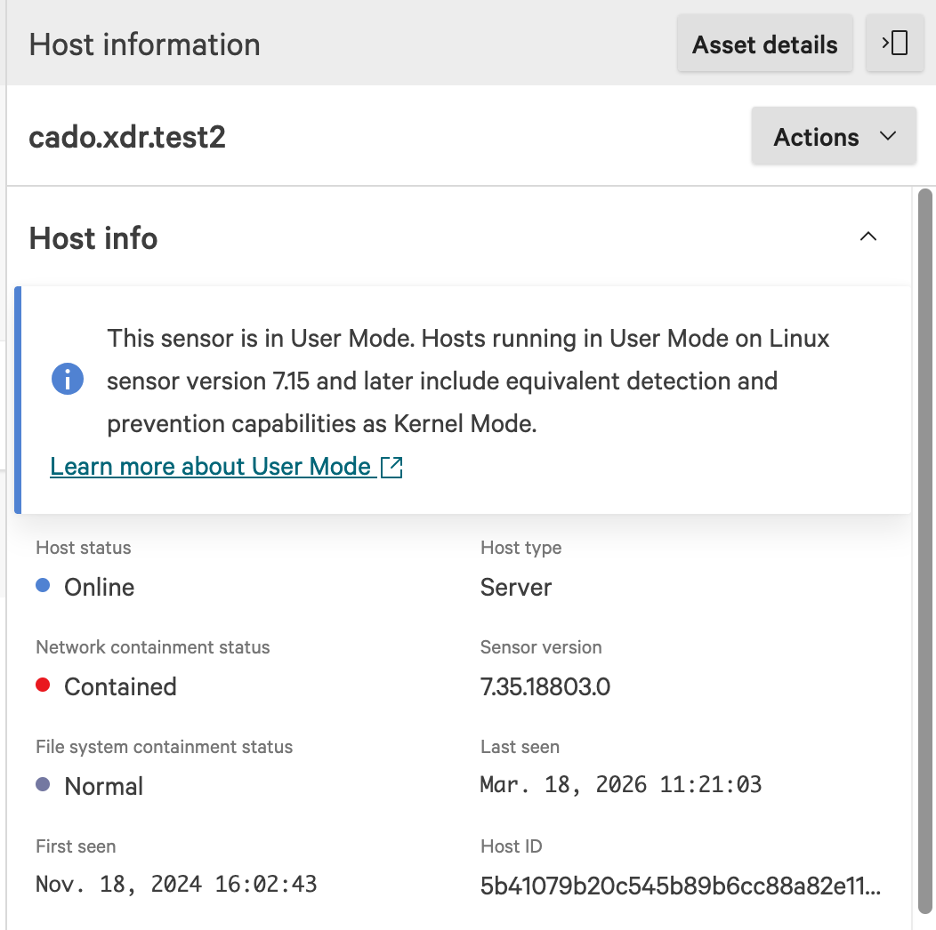
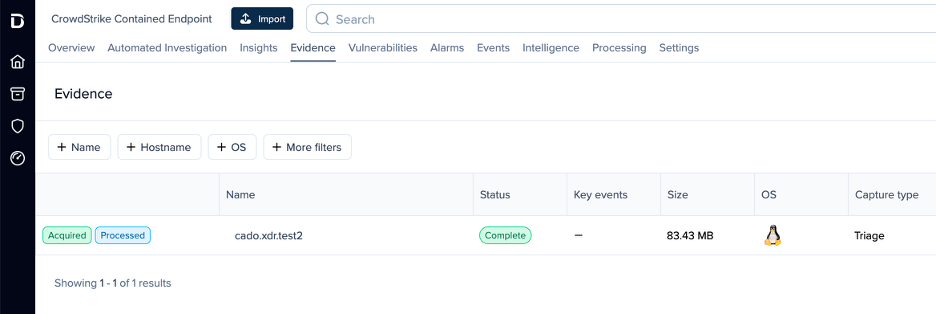
Luckily, taking advantage of automated forensic data capture of non-cloud assets won’t be subject to those who purely use Darktrace / ENDPOINT. This functionality is also available where CrowdStrike, Microsoft Defender for Endpoint, or SentinelOne agents are deployed.  In the case of CrowdStrike, Darktrace / Forensic Acquisition & Investigation can also perform a triage capture of a device that has been contained using CrowdStrike’s network containment capability. What’s critical here is the fact that investigators can safely acquire additional forensic evidence without breaking or altering containment. That massively improves investigation and response time without adding more risk factors.

Figure 4: ‘cado.xdr.test2’ has been contained using CrowdStrike’s network containment capability
Figure 5: Successful triage capture of contained endpoint ‘cado.xdr.test2’ using / Forensic Acquisition & Investigation

The benefits of extending forensics to on‑premises and endpoint environments

Despite Darktrace / Forensic Acquisition & Investigation originating as a cloud‑first solution, the challenges of incident response are not limited to the cloud. Many investigations span on‑premises servers, unmanaged endpoints, legacy systems, or devices locked inside third‑party ecosystems.  

By extending automated investigation capabilities into on‑premises environments and endpoints, Darktrace delivers several critical benefits:

  • Unified investigations across hybrid infrastructure and a heterogeneous security stack
  • Consistent forensic depth regardless of asset type
  • Faster and more accurate root-cause analysis
  • Stronger incident response readiness

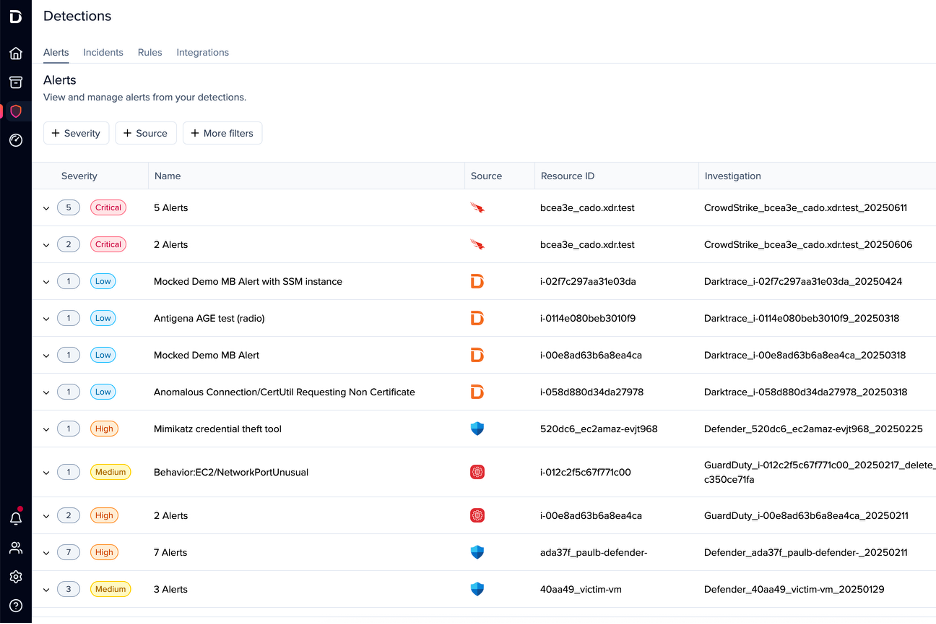
Figure 6: Unified alerts from cloud and on-prem environments, grouped into incident-centric investigations with forensic depth

Simplifying deep investigations across hybrid environments

These enhancements move Darktrace / Forensic Acquisition & Investigation closer to a vision out of reach for most security teams: seamless, integrated, high‑fidelity forensics across cloud, on‑prem, and endpoint environments where other solutions usually stop at detection. Automated forensics as a whole is fueling faster outcomes with complete clarity throughout the end-to-end investigation process, which now takes teams from alert to understanding in minutes compared to days or even weeks. All without added agents, disruptions, or specialized teams. The result is an incident response lifecycle that finally matches the reality of modern infrastructure.

Ready to see Darktrace / Forensic Acquisition & Investigation in your environment? Request a demo.

Hear from industry-leading experts on the latest developments in AI cybersecurity at Darktrace LIVE. Coming to a city near you.

[related-resource]

Continue reading
About the author
Paul Bottomley
Director of Product Management | Darktrace

Blog

/

AI

/

April 10, 2026

How to Secure AI and Find the Gaps in Your Security Operations

secuing AI testing gaps security operationsDefault blog imageDefault blog image

What “securing AI” actually means (and doesn’t)

Security teams are under growing pressure to “secure AI” at the same pace which businesses are adopting it. But in many organizations, adoption is outpacing the ability to govern, monitor, and control it. When that gap widens, decision-making shifts from deliberate design to immediate coverage. The priority becomes getting something in place, whether that’s a point solution, a governance layer, or an extension of an existing platform, rather than ensuring those choices work together.

At the same time, AI governance is lagging adoption. 37% of organizations still lack AI adoption policies, shadow AI usage across SaaS has surged, and there are notable spikes in anomalous data uploads to generative AI services.  

First and foremost, it’s important to recognize the dual nature of AI risk. Much of the industry has focused on how attackers will use AI to move faster, scale campaigns, and evade detection. But what’s becoming just as significant is the risk introduced by AI inside the organization itself. Enterprises are rapidly embedding AI into workflows, SaaS platforms, and decision-making processes, creating new pathways for data exposure, privilege misuse, and unintended access across an already interconnected environment.

Because the introduction of complex AI systems into modern, hybrid environments is reshaping attacker behavior and exposing gaps between security functions, the challenge is no longer just having the right capabilities in place but effectively coordinating prevention, detection, investigation, response, and remediation together. As threats accelerate and systems become more interconnected, security depends on coordinated execution, not isolated tools, which is why lifecycle-based approaches to governance, visibility, behavioral oversight, and real-time control are gaining traction.

From cloud consolidation to AI systems what we can learn

We have seen a version of AI adoption before in cloud security. In the early days, tooling fragmented into posture, workload/runtime, identity, data, and more. Gradually, cloud security collapsed into broader cloud platforms. The lesson was clear: posture without runtime misses active threats; runtime without posture ignores root causes. Strong programs ran both in parallel and stitched the findings together in operations.  

Today’s AI wave stretches that lesson across every domain. Adversaries are compressing “time‑to‑tooling” using LLM‑assisted development (“vibecoding”) and recycling public PoCs at unprecedented speed. That makes it difficult to secure through siloed controls, because the risk is not confined to one layer. It emerges through interactions across layers.

Keep in mind, most modern attacks don’t succeed by defeating a single control. They succeed by moving through the gaps between systems faster than teams can connect what they are seeing. Recent exploitation waves like React2Shell show how quickly opportunistic actors operationalize fresh disclosures and chain misconfigurations to monetize at scale.

In the React2Shell window, defenders observed rapid, opportunistic exploitation and iterative payload diversity across a broad infrastructure footprint, strains that outpace signature‑first thinking.  

You can stay up to date on attacker behavior by signing up for our newsletter where Darktrace’s threat research team and analyst community regularly dive deep into threat finds.

Ultimately, speed met scale in the cloud era; AI adds interconnectedness and orchestration. Simple questions — What happened? Who did it? Why? How? Where else? — now cut across identities, SaaS agents, model/service endpoints, data egress, and automated actions. The longer it takes to answer, the worse the blast radius becomes.

The case for a platform approach in the age of AI

Think of security fusion as the connective tissue that lets you prevent, detect, investigate, and remediate in parallel, not in sequence. In practice, that looks like:

  1. Unified telemetry with behavioral context across identities, SaaS, cloud, network, endpoints, and email—so an anomalous action in one plane automatically informs expectations in others. (Inside‑the‑SOC investigations show this pays off when attacks hop fast between domains.)  
  1. Pre‑CVE and “in‑the‑wild” awareness feeding controls before signatures—reducing dwell time in fast exploitation windows.  
  1. Automated, bounded response that can contain likely‑malicious actions at machine speed without breaking workflows—buying analysts time to investigate with full context. (Rapid CVE coverage and exploit‑wave posts illustrate how critical those first minutes are.)  
  1. Investigation workflows that assume AI is in the loop—for both defenders and attackers. As adversaries adopt “agentic” patterns, investigations need graph‑aware, sequence‑aware reasoning to prioritize what matters early.

This isn’t theoretical. It’s reflected in the Darktrace posts that consistently draw readership: timely threat intel with proprietary visibility and executive frameworks that transform field findings into operating guidance.  

The five questions that matter (and the one that matters more)

When alerted to malicious or risky AI use, you’ll ask:

  1. What happened?
  1. Who did it?
  1. Why did they do it?
  1. How did they do it?
  1. Where else can this happen?

The sixth, more important question is: How much worse does it get while you answer the first five? The answer depends on whether your controls operate in sequence (slow) or in fused parallel (fast).

What to watch next: How the AI security market will likely evolve

Security markets tend to follow a familiar pattern. New technologies drive an initial wave of specialized tools (posture, governance, observability) each focused on a specific part of the problem. Over time, those capabilities consolidate as organizations realize the new challenge is coordination.

AI is accelerating the shift of focus to coordination because AI-powered attackers can move faster and operate across more systems at once. Recent exploitation waves show exactly this. Adversaries can operationalize new techniques and move across domains, turning small gaps into full attack paths.

Anticipate a continued move toward more integrated security models because fragmented approaches can’t keep up with the speed and interconnected nature of modern attacks.

Building the Groundwork for Secure AI: How to Test Your Stack’s True Maturity

AI doesn’t create new surfaces as much as it exposes the fragility of the seams that already exist.  

Darktrace’s own public investigations consistently show that modern attacks, from LinkedIn‑originated phishing that pivots into corporate SaaS to multi‑stage exploitation waves like BeyondTrust CVE‑2026‑1731 and React2Shell, succeed not because a single control failed, but because no control saw the whole sequence, or no system was able to respond at the speed of escalation.  

Before thinking about “AI security,” customers should ensure they’ve built a security foundation where visibility, signals, and responses can pass cleanly between domains. That requires pressure‑testing the seams.

Below are the key integration questions and stack‑maturity tests every organization should run.

1. Do your controls see the same event the same way?

Integration questions

  • When an identity behaves strangely (impossible travel, atypical OAuth grants), does that signal automatically inform your email, SaaS, cloud, and endpoint tools?
  • Do your tools normalize events in a way that lets you correlate identity → app → data → network without human stitching?

Why it matters

Darktrace’s public SOC investigations repeatedly show attackers starting in an unmonitored domain, then pivoting into monitored ones, such as phishing on LinkedIn that bypassed email controls but later appeared as anomalous SaaS behavior.

If tools can’t share or interpret each other's context, AI‑era attacks will outrun every control.

Tests you can run

  1. Shadow Identity Test
  • Create a temporary identity with no history.
  • Perform a small but unusual action: unusual browser, untrusted IP, odd OAuth request.
  • Expected maturity signal: other tools (email/SaaS/network) should immediately score the identity as high‑risk.
  1. Context Propagation Test
  • Trigger an alert in one system (e.g., endpoint anomaly) and check if other systems automatically adjust thresholds or sensitivity.
  • Low maturity signal: nothing changes unless an analyst manually intervenes.

2. Does detection trigger coordinated action, or does everything act alone?

Integration questions

  • When one system blocks or contains something, do other systems automatically tighten, isolate, or rate‑limit?
  • Does your stack support bounded autonomy — automated micro‑containment without broad business disruption?

Why it matters

In public cases like BeyondTrust CVE‑2026‑1731 exploitation, Darktrace observed rapid C2 beaconing, unusual downloads, and tunneling attempts across multiple systems. Containment windows were measured in minutes, not hours.  

Tests you can run

  1. Chain Reaction Test
  • Simulate a primitive threat (e.g., access from TOR exit node).
  • Your identity provider should challenge → email should tighten → SaaS tokens should re‑authenticate.
  • Weak seam indicator: only one tool reacts.
  1. Autonomous Boundary Test
  • Induce a low‑grade anomaly (credential spray simulation).
  • Evaluate whether automated containment rules activate without breaking legitimate workflows.

3. Can your team investigate a cross‑domain incident without swivel‑chairing?

Integration questions

  • Can analysts pivot from identity → SaaS → cloud → endpoint in one narrative, not five consoles?
  • Does your investigation tooling use graphs or sequence-based reasoning, or is it list‑based?

Why it matters

Darktrace’s Cyber AI Analyst and DIGEST research highlights why investigations must interpret structure and progression, not just standalone alerts. Attackers now move between systems faster than human triage cycles.  

Tests you can run

  1. One‑Hour Timeline Build Test
  • Pick any detection.
  • Give an analyst one hour to produce a full sequence: entry → privilege → movement → egress.
  • Weak seam indicator: they spend >50% of the hour stitching exports.
  1. Multi‑Hop Replay Test
  • Simulate an incident that crosses domains (phish → SaaS token → data access).
  • Evaluate whether the investigative platform auto‑reconstructs the chain.

4. Do you detect intent or only outcomes?

Integration questions

  • Can your stack detect the setup behaviors before an attack becomes irreversible?
  • Are you catching pre‑CVE anomalies or post‑compromise symptoms?

Why it matters

Darktrace publicly documents multiple examples of pre‑CVE detection, where anomalous behavior was flagged days before vulnerability disclosure. AI‑assisted attackers will hide behind benign‑looking flows until the very last moment.

Tests you can run

  1. Intent‑Before‑Impact Test
  • Simulate reconnaissance-like behavior (DNS anomalies, odd browsing to unknown SaaS, atypical file listing).
  • Mature systems will flag intent even without an exploit.
  1. CVE‑Window Test
  • During a real CVE patch cycle, measure detection lag vs. public PoC release.
  • Weak seam indicator: your detection rises only after mass exploitation begins.

5. Are response and remediation two separate universes?

Integration questions

  • When you contain something, does that trigger root-cause remediation workflows in identity, cloud config, or SaaS posture?
  • Does fixing a misconfiguration automatically update correlated controls?

Why it matters

Darktrace’s cloud investigations (e.g., cloud compromise analysis) emphasize that remediation must close both runtime and posture gaps in parallel.

Tests you can run

  1. Closed‑Loop Remediation Test
  • Introduce a small misconfiguration (over‑permissioned identity).
  • Trigger an anomaly.
  • Mature stacks will: detect → contain → recommend or automate posture repair.
  1. Drift‑Regression Test
  • After remediation, intentionally re‑introduce drift.
  • The system should immediately recognize deviation from known‑good baseline.

6. Do SaaS, cloud, email, and identity all agree on “normal”?

Integration questions

  • Is “normal behavior” defined in one place or many?
  • Do baselines update globally or per-tool?

Why it matters

Attackers (including AI‑assisted ones) increasingly exploit misaligned baselines, behaving “normal” to one system and anomalous to another.

Tests you can run

  1. Baseline Drift Test
  • Change the behavior of a service account for 24 hours.
  • Mature platforms will flag the deviation early and propagate updated expectations.
  1. Cross‑Domain Baseline Consistency Test
  • Compare identity’s risk score vs. cloud vs. SaaS.
  • Weak seam indicator: risk scores don’t align.

Final takeaway

Security teams should ask be focused on how their stack operates as one system before AI amplifies pressure on every seam.

Only once an organization can reliably detect, correlate, and respond across domains can it safely begin to secure AI models, agents, and workflows.

Continue reading
About the author
Nabil Zoldjalali
VP, Field CISO
Your data. Our AI.
Elevate your network security with Darktrace AI